Most software implementations succeed. But they don’t maximise the value.
Why? Because they stop at go-live.
A platform is bought with ambitious plans, implemented under pressure and configured to solve the immediate problem. The deadline is met, the system works and everyone moves on.
What rarely happens is the second phase: stepping back and asking, “What else could this technology do for us?”
We see this repeatedly with tax and finance technology.
Sophisticated platforms end up supporting processes still dominated by spreadsheets, manual data transfers, repetitive reconciliations and workarounds.
The technology is working but the business may be using only a fraction of what it has paid for.
That is the problem we help solve.
At Osprey, we work with tax and finance teams to identify where they are not getting full value from the technology they already own, and then help them implement the automation, integration, reporting and process flow capabilities that are unutilised.
And we think there is a much bigger opportunity here than many teams realise.
The gap between capability and utilisation
This is rarely the result of a bad technology decision.
Software implementations happen around deadlines. The priority is getting the immediate process working, getting the numbers out and meeting the reporting timetable.
So teams learn the quickest route to the required output and everything else can wait.
Automation, integration, reporting and process flows often require additional configuration and specialist knowledge. Once the immediate pressure has gone, there is rarely anyone with the time to step back and ask what else could be done.
The business has effectively created a form of technology debt. The technology is neither old nor broken. The business has simply paid for capability that it has never invested the time to realise.
The hidden cost of technology debt
This is an easy problem to overlook because the software is technically working.
- The reports are produced.
- The numbers get signed off.
- The process gets through another cycle.
So why change it?
Because “working” and “working efficiently” are not the same thing.
If people are repeatedly exporting data into Excel, manipulating it and putting it back into the system, the technology may be working perfectly well.
If someone spends hours every month preparing a report that the platform could potentially produce automatically, the technology may not be the constraint.
If reviewers are managing approvals through emails and spreadsheets while the underlying platform has workflow capability, the problem may not be the absence of technology.
Where the value is often hiding
The opportunities are usually not obscure features buried somewhere in a user manual.
They tend to sit around the core process. Data is one obvious example.
How much information is still being extracted from another system, manipulated in Excel and then uploaded or rekeyed into the platform?
Then there is integration.
Is the technology properly connected to the systems around it, or has it effectively become an island that people continually copy information into and out of?
Reporting is another.
Are people exporting information and rebuilding reports in Excel because that is how the process has always worked?
And then there is process flow.
Does the technology support the review, approval and sign-off process, or is the system simply being used as a calculation engine while the actual process happens elsewhere?
These are often the areas where the gap between what a platform can do and what a business actually uses it for becomes most visible.
The question to ask before buying something new
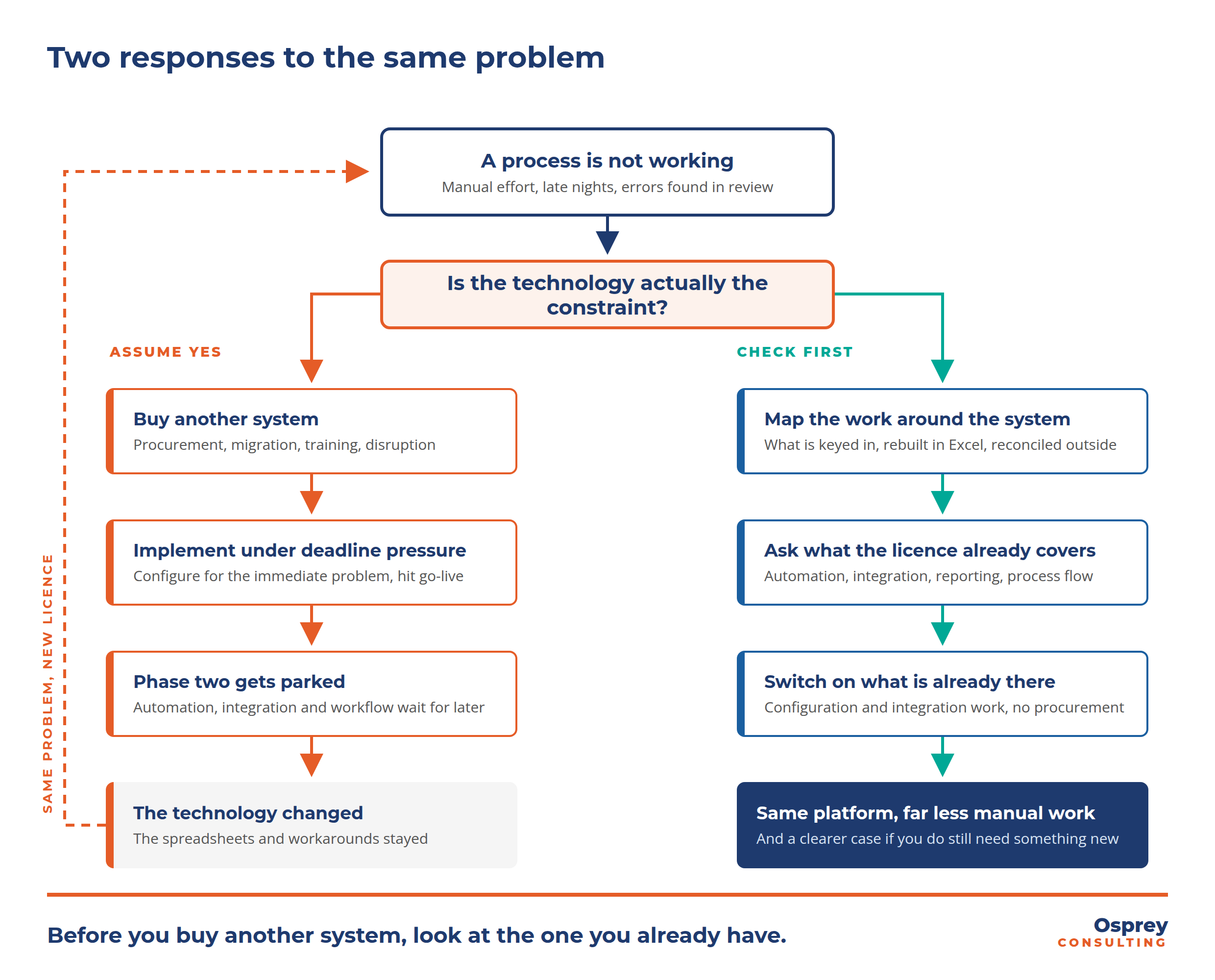
When a business identifies a problem with its current process, the natural response is often to look for another technology solution.
Sometimes that is exactly the right answer.
But there is a question we think should come first:
Is the technology actually the constraint?
If the existing platform is only being used for a fraction of what it can do, replacing it may simply reproduce the same problem with a different piece of software.
The technology changes.
The spreadsheets remain.
The manual processes remain.
The workarounds remain.
Optimising what you already own gives you a much better answer.
And if you eventually conclude that you really do need something different, you are making that decision with a much clearer understanding of what the existing platform can and cannot do.
That is a much better starting point for a technology investment.
Look at the economics
There is also a straightforward financial argument.
Before committing budget to another licence, ask how much value is sitting unused in the licences you already pay for.
A manual process that takes a few hours each month might not appear significant.
But multiply that across entities, reporting cycles and years, and the hidden cost of leaving it manual can become substantial.
Then consider the cost of introducing another system: procurement, implementation, data migration, integration, training and the disruption that inevitably comes with change.
New technology is sometimes the right call.
But understanding the technology you already own should come before deciding that you need more.
A simple exercise
Take an hour and map the work that happens around your technology.
List:
- the data your team still keys in
- the information they extract
- the spreadsheets they maintain
- the reports they rebuild
- the reconciliations they perform outside the system
- the repetitive steps they carry out every month because “that is how we do it”
Then ask one question for each item:
Could the technology we already own do this?
You may find the list is considerably longer than you expected, especially if you have not kept up to date with the software releases since initial implementation.
And that is potentially good news.
Because some of those problems may already have a solution sitting inside your existing technology ecosystem.
You just have not switched it on yet.
Where experience makes a difference
Getting more from an existing platform is not simply a case of reading the manual.
It requires an understanding of the product, the underlying tax and finance processes, the data feeding them and the systems around them.
It also requires practical implementation experience: knowing what is possible, what is worth doing and how to make it work within the way a business actually operates.
That is where we come in.
At Osprey, we help businesses get more from the ONESOURCE technology they already own, whether that means improving data flows, automating processes, integrating systems, improving reporting or making the wider workflow more effective.
On one project, we enhanced a multinational group’s existing ONESOURCE Corporate Tax implementation with two Alteryx workflows and API integrations. A tax process that used to take four weeks now runs in minutes.
Using more features for the sake of it achieves nothing.
The objective is to make the technology work harder for the business.
Before you buy another system, find out what the one you already own can do.
You might be surprised.
If you suspect you are using only a fraction of what your ONESOURCE licence can do, we’d be happy to spend 30 minutes looking at where there may be untapped capability.