Statutory accounts look simple from a distance. One company, one set of accounts, prepared once a year under the relevant framework and filed. For a single entity that is exactly what it is, and it is why the difficulty at scale catches so many groups out. The skills that produce one flawless set of accounts are not the skills that produce ten or fifty consistent ones on time, and the gap between those two things is not accounting. It is logistics.
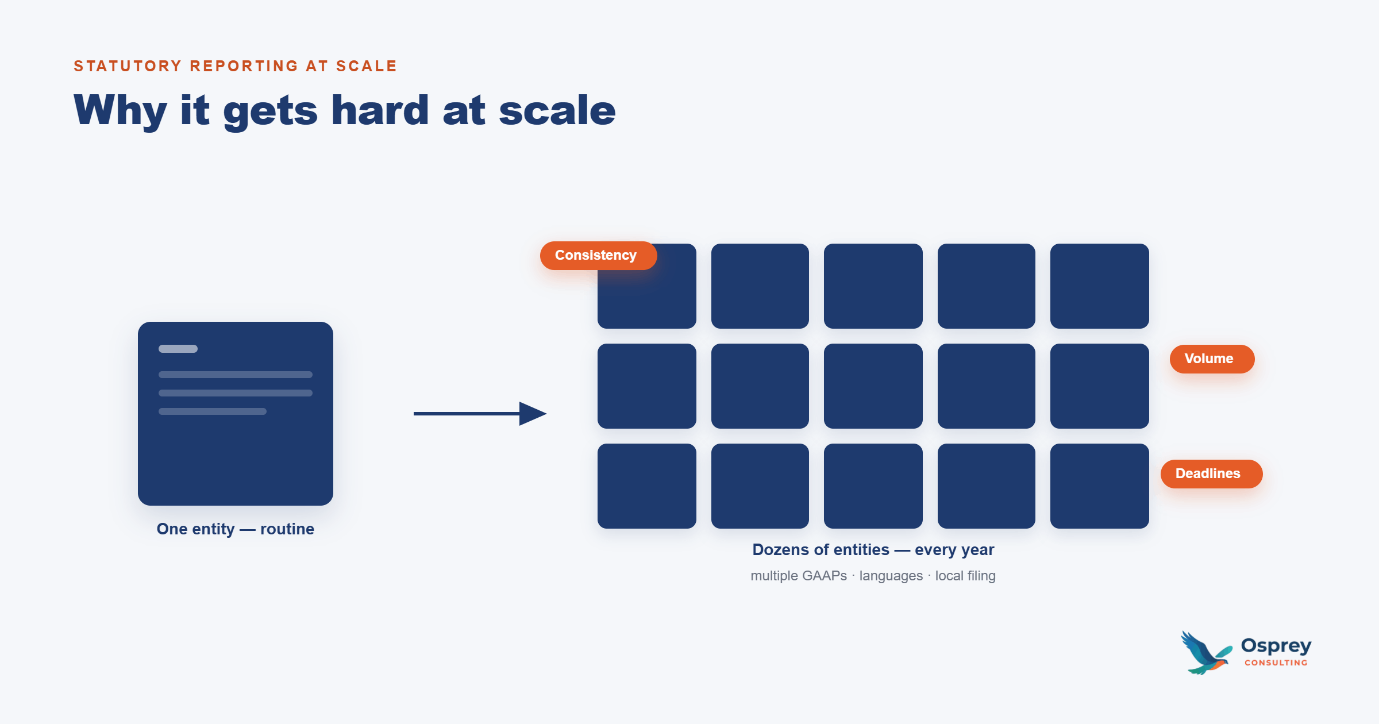
Take that single set of accounts and multiply it: fifty entities, a dozen countries, several frameworks, different languages, each with its own local rules and deadlines. The job is no longer to prepare a set of accounts, it is to produce dozens of them, consistently and on time, every year. Three pressures show up that a single company never feels. Fifty entities prepared by different hands drift into fifty subtly different documents, so consistency becomes real work. The same data movements and checks repeat for every entity every period, so with a manual process the workload rises in a straight line with the entity count. And every change in the rules has to reach every affected entity.
When I watch a statutory team at scale, the hours are not going where you might think. They go on processing: pulling and reformatting trial balances, shifting numbers between systems, typing the same disclosures across dozens of documents, chasing entities for the same information in slightly different shapes each time, and assembling files for filing. The accounting settles early. The logistics never do. That is worth sitting with for a moment, because it means most groups are paying senior rates for people to do low value work that the process itself should be doing.
The rule change removes the escape routes. From 1 April 2028, UK accounts must be filed through commercial software, in structured, tagged form, and the web and paper routes close. If your accounts are assembled by hand and converted at the end, you will feel that in every entity, including the small and dormant ones that always took the simplest path. If your process produces structured output as it goes, you will barely notice the date. The reform does not create the scale problem, but it does put a deadline on ignoring it, and it quietly takes away the manual shortcuts a lot of groups have leaned on.
We have done this work, most recently on ONESOURCE Statutory Reporting for an asset manager, two banks and a logistics group. The pattern held each time: get the templated process genuinely consistent first, then automate the flows that feed it, and preparation time falls a long way while the accounts come out software-ready rather than hand-converted at the end. Financial services feels this earlier than most, partly because these groups carry more entities and more disclosure, and partly because of the sector-specific tags that sit outside the “standard” taxonomy. That is exactly the kind of knowledge that is safer to build into the process once and removes key person dependency.
If you want a quick sense of where you stand, take one entity’s accounts and count the hands that touch its numbers between the trial balance and the filed document. Then ask how much of what those hands do is judgement, and how much is just moving data around. If the moving-around wins, and at scale it usually does, that is the process to redesign, and the 2028 clock makes this the year to do it in the quiet rather than against a deadline.
None of this is really about satisfying Companies House. A statutory process that produces consistent, structured, software-ready accounts as a matter of course also closes faster, audits more smoothly, and lets experienced people spend their time reviewing the accounts instead of assembling them. The regulation is the prompt and the deadline. The calmer year-end is the prize.
If your group is feeling the strain of statutory reporting at scale, download our Companies House 2028 readiness checklist, ten questions that show where a group stands, or book a 30-minute call about what a sustainable approach looks like at your entity count.