A while ago I sat down with the tax team of a large multi-national group and asked them the question: where does your year go? Not the technical calls, which clearly they enjoyed, but the hours. We added it up honestly. The best part of a month, every year, went on moving and reshaping data before anyone could do the work they were hired for. Thirty-odd entities, a heavy asset base, and a timetable owned by spreadsheets. It looked like ordinary work, and ordinary work is the most expensive thing in a tax function, because it hides in plain sight and nobody thinks to cost it.
Two jobs were eating those weeks. The first was capital allowances. To get to the position, the team pulled detailed pool and asset data out of the compliance system, trued up the prior-year year-end pools against what had finally been filed, worked out how the current year’s additions split across pools by looking at how last year’s had been allocated, and then reshaped the lot into the exact format the next tool wanted for upload. None of that is hard, taken one step at a time. Across a big asset base and thirty entities it came to about two weeks, and every one of those manual steps was somewhere a wrong number could slip in and flow straight through to deferred tax.
The second job was the group provision workbook, and it had the same shape. Every year someone rebuilt the prior-year file by hand, carried the categories across, re-keyed the finalised prior-year figures from the corporate tax system, and then assembled the current period on top. Another fortnight, and the same quiet risk, because the people doing it were working hard and it was the busiest point of their year.
What we built. We replaced both with automated workflows, built in Alteryx and sitting on top of the systems they already ran. The first does capital allowances end to end: it pulls the pool and additions data via API, trues up the prior year, allocates the current-year additions on the prior-year logic, and writes the output in exactly the format the next system needs. The second handles the provision workbook. It rolls the prior-year file forward, pulls the finalised prior-year figures straight from ONESOURCE Corporate Tax across every category the group tracks, and then pulls the current period to finish the job. We did not replace a single piece of software. We changed how the data moved, which meant no migration, no re-training, and nothing touching a live cycle.
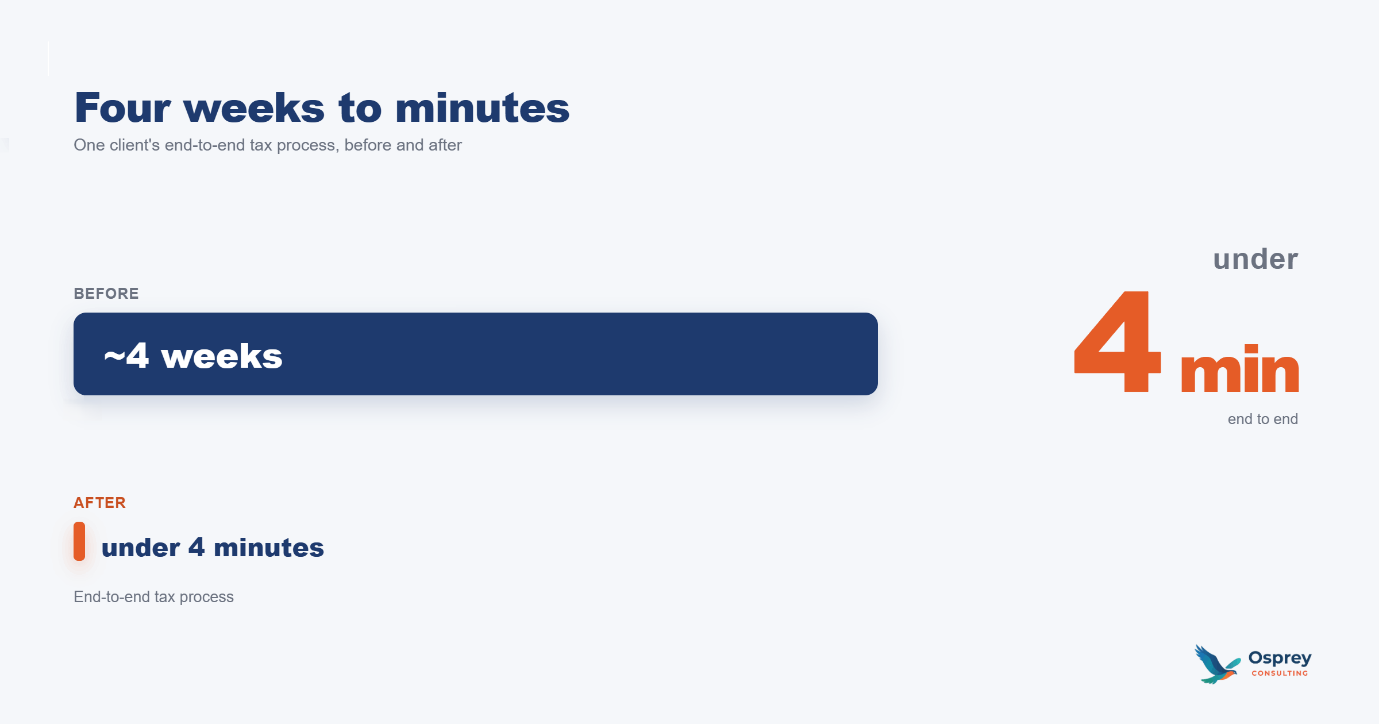
The number people remember is that about four weeks became about four minutes. What I remember is the change in what the team spent its time on. The re-keying risk went, because the re-keying went. Every figure now had a path you could follow from source to output. And a group of experienced tax people stopped spending a month a year on data entry and started spending it on judgement, which is what they were good at and what they were being paid for.
I would not want anyone to read that as a one-off. The reason these two jobs automated so well is a pattern you can look for yourself: high volume, repetitive steps, a heavy dependence on last year’s numbers, and an output needed in a fixed shape. Wherever those four things turn up together, there is usually a workflow waiting to be built, and in a group of any size they turn up all over the place, in intercompany schedules, roll-forwards, reconciliations and upload files of every kind. Capital allowances was simply the clearest example, which made it the right place to start.
One last thing, because it matters more than the four minutes. Both workflows are documented and owned by the client’s team. They can see the logic, they run it themselves, and they can change it when the business changes. There is no dependency on us, and the handover was part of the job, not something we sold back afterwards. I feel strongly about this.
If a process in your own group has that profile, high volume, repetitive, needed in a set format, it is worth half an hour to hold it up against this one. The first question is never which software to buy. It is which single job is quietly costing you the most for the least judgement, because that is almost always where to start.
If a high-volume data task is eating your tax timetable, book a 30-minute call and bring it with you. We will tell you honestly whether it fits the pattern.