I have watched a lot of good tax technology cases die. Not because the idea was wrong, but because it was argued in the wrong language. Tax often makes the case in the terms that feel obvious from inside the function, efficiency, accuracy, fewer errors, and the CFO across the table is thinking about something else entirely: return, risk, and where this sits against everything else asking for the same money. Marketing wants a campaign, operations wants people, and they are all promising efficiency too, with revenue attached. A case that stays in tax language joins that queue. A case put in the board’s language jumps it.
So I would start nowhere near the solution. I would start with what doing nothing actually costs, written down as a number. How many hours in a period go on moving and reformatting data, times a sensible day rate, times the cycles in a year. What rework costs when a figure moves late and a dozen schedules have to be redone. What happens the day the one person who understands the model resigns, and what a recruiter plus a six-month handover would cost to replace them. Rough figures are fine here; you are not auditing, you are sizing. I have almost never seen a team do this exercise and not surprise themselves, because the cost of carrying on is real and nobody had ever added it up.
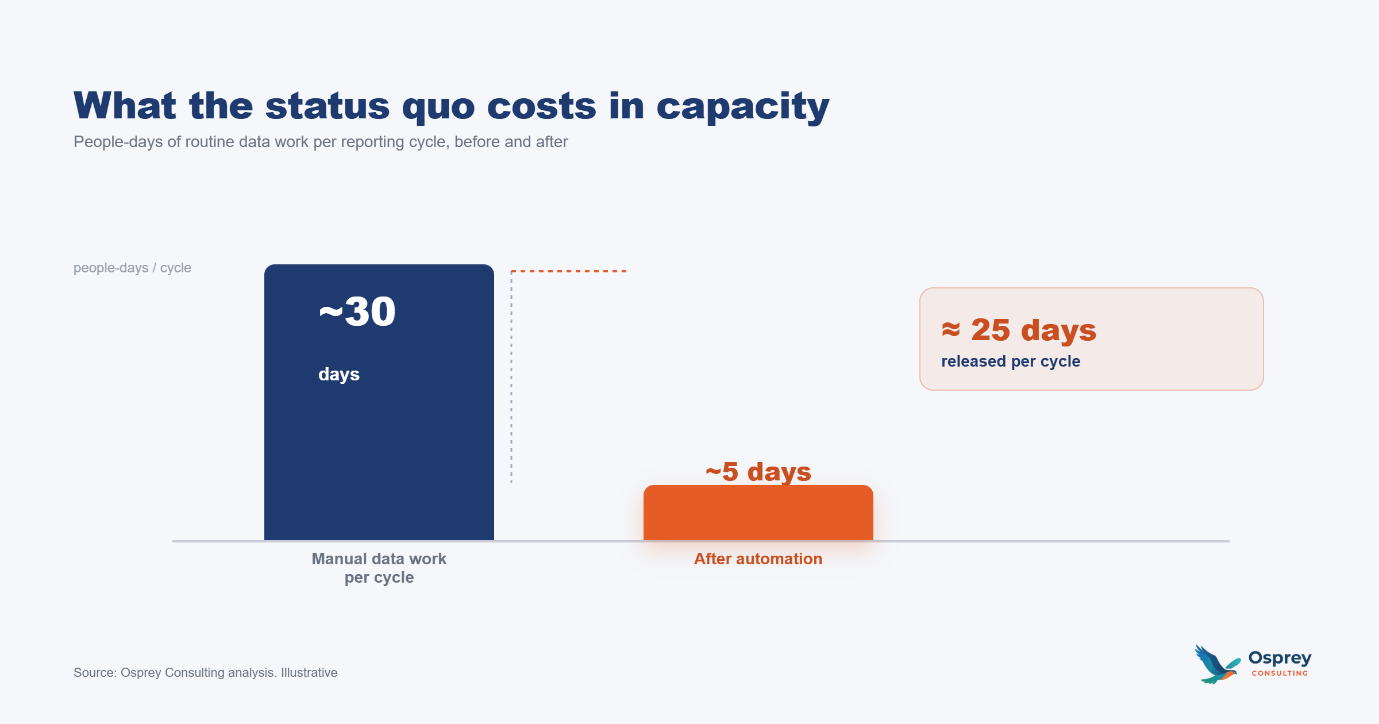
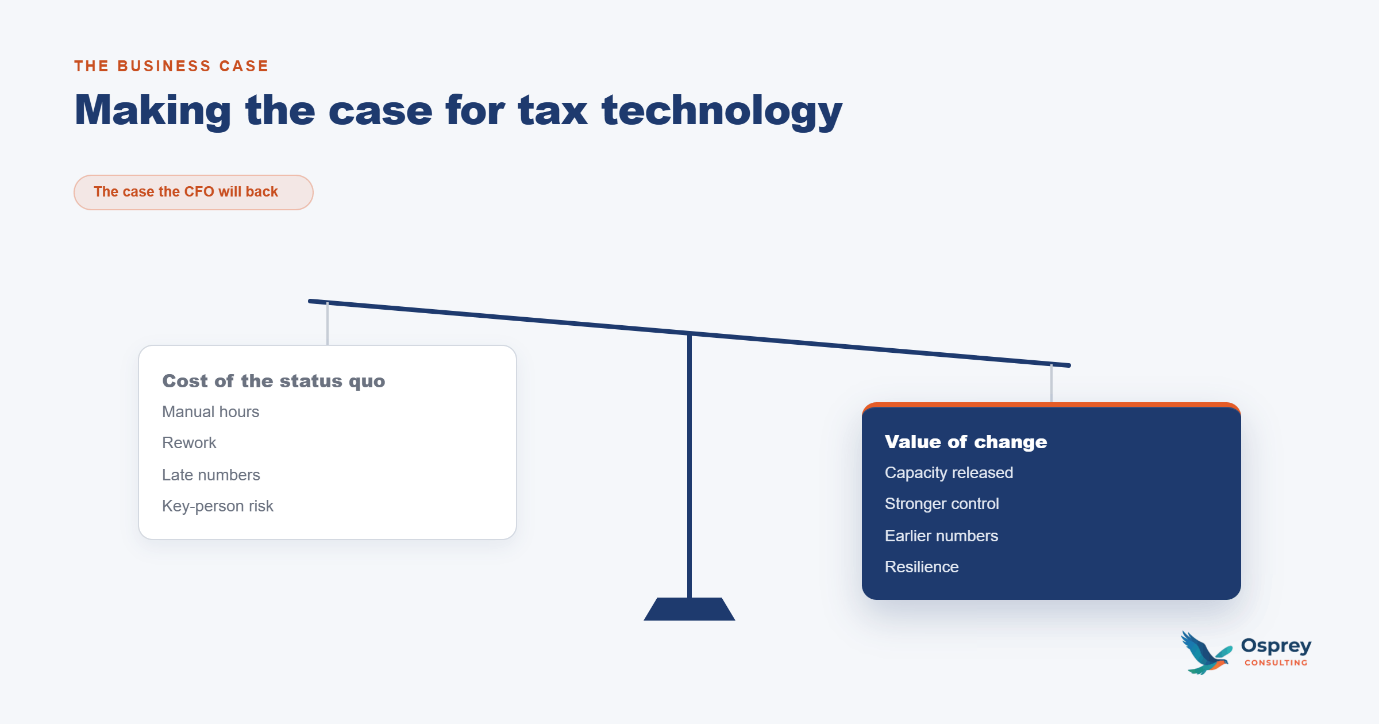
Once that number is on the page, the benefits translate themselves. Hours saved become capacity, so the team takes on the next project without new headcount. Cleaner, traceable data becomes lower risk and a calmer audit. A faster process becomes earlier numbers, so tax informs the decision instead of explaining it afterwards. A documented process becomes resilience, so nothing hangs on one person staying. None of those are tax words, and that is the point. They are the words a board already uses to decide things.
Attach it to a worry they already have. A case lands hardest when it is not really a new request at all, but the answer to something the organisation has already admitted. A filing deadline. The year-end that overran and got mentioned at the audit committee. A finding about spreadsheet controls. A growth plan the current team cannot resource. Hang your case on one of those and the argument stops being whether to spend the money and becomes how, which is a much better conversation to be having.
And I would resist asking for everything at once, however tempting. A big programme invites big scrutiny, a long procurement, and higher risk. A small, contained first step does two things a slide cannot: it gives the team time back in weeks, and it turns your case from a projection into evidence. That group I mentioned took a four-week job down to about four minutes with one tightly scoped piece of work, and that single before-and-after now does the arguing for them internally. People do not argue with a number their own team produced.
Let me make that concrete. Picture a Head of Tax whose provision lives in a workbook only one manager really understands. The weak version of the case is we should modernise the provision for better accuracy and compliance, and it will wait forever. The strong version fits on a page: this takes twelve days of senior time every year end, half that a quarter, plus time from the rest of the team, costs us something like fifty thousand a year, and relies entirely on one person; automating the roll-forward, trial-balance load and all the report creation and reconciliations would cut it to under three days and remove the key-person risk the audit committee already flagged; we would like to do that one piece first, measure it, and decide the rest afterwards. Same facts, same software. One version gets deferred and the other gets a yes, because it speaks in return and risk and asks for a decision the board knows how to make. Of course, throw in the risks around Pillar 2 and the case just gets stronger.
That is the whole discipline, really. One page. What today costs. The first step and its price. The result you will show, and when. The decision you want. Anything longer dilutes it and anything vaguer delays it. Get those four things down and the meeting turns from why should we spend this into why on earth have we not done it already.
I know this is the part many tax leaders least enjoy, but the alternative is watching good ideas quietly not happen. If a second pair of eyes on the numbers behind your own case would help, that is a conversation I am always happy to have.
If you are building the case for your own function, start with our case study, From Four Weeks to Four Minutes; it is the before-and-after a CFO recognises. And if you would like help putting your own numbers together, book a 30-minute call.