There is a particular quiet that settles over a tax team once a close is finally behind it. The last cycle is closed, the audit queries have stopped, and for a few weeks the inbox behaves. It is tempting to treat that quiet as a finish line. In my experience it is the opposite: it is the single best window you will get all year to make the next close easier.
The pattern I have watched play out more times than I can count is this. A team comes through a punishing year-end, promises itself next time will be different, and gets swept straight back into business as usual. The improvement never happens, the work that would have saved time and stress never gets started.
The close is built in the months before it. It helps to think of year-end not as an event but as the visible tip of a process that has been running, quietly, for months. A close runs late because of data that arrives in the wrong shape, a reconciliation no one owns, the spreadsheet one person understands who is on leave or off sick, the adjustment that ripples through fifteen schedules because nothing is connected. None of those can be fixed once the close is under way. Every one can be fixed now.
Fix one thing properly, not five things halfway. Given a clear window there is a strong pull to launch a grand transformation. Resist it. The teams that actually improve year on year pick one thing and finish it. And in my experience the single highest-value move is usually not another clever workaround, it is giving a straining task its own dedicated software. If your provision, your corporate tax computations or your statutory accounts are being held together by a spreadsheet that has quietly become business-critical, the fix that pays back most is a proper tool built for the job. That is the targeted task worth choosing. Making the case for that spend is a task in itself, and the subject of another piece on building an internal business case. If dedicated software is too big a step for this window, or you already have the right tool and it is the work around it that hurts, take the smaller, discrete version: pick the single most painful, most repeated task and improve and automate around what you have. One workflow that genuinely works beats five that are nearly finished and trusted by no one.
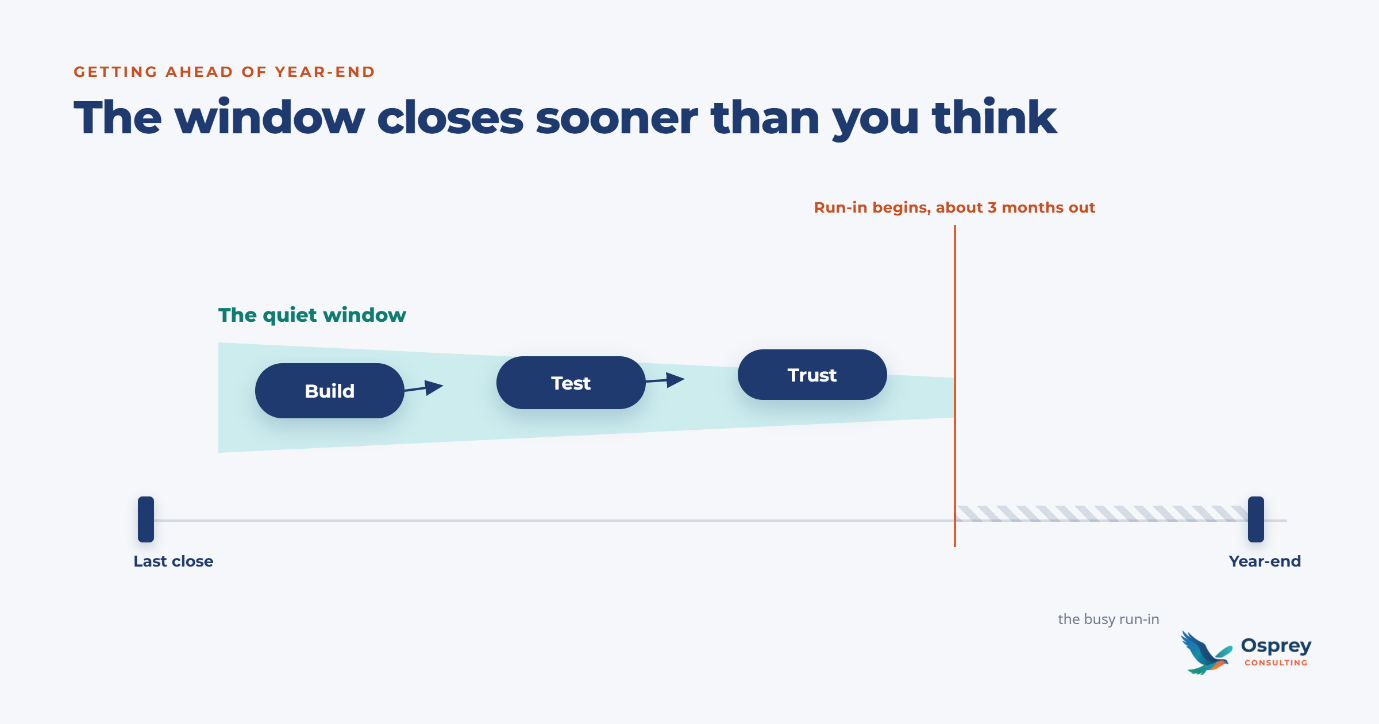
The real deadline comes months before year-end. If you have just come through a close, you have a deadline you may not have noticed. It is the point, roughly three months before your next year-end, when the run-in begins and the window for change quietly closes. Anything you want working smoothly in the busy season has to be built, tested and trusted before then, and that is tighter than it looks, because buying or building something is only half the job. The other half is running it on real data, finding what breaks, and fixing it while the stakes are low.
A practical place to begin. If you do nothing else in this window, take the one task your team struggled with most last close and ask why it hurts. Often it is a job a spreadsheet was never meant to do, or a manual step that survives only because no one has had time to remove it or to buy the tool that would. Deal with those first: it saves not just the hours they take but the errors they cause, the late nights they create and the key-person risk they hide. The quiet will not last. The question is whether you spend it resting on the last close or quietly dismantling the reasons the next one will be hard.
At Osprey we help teams use exactly this window to get the right software in place and streamline the cycle around it, whether that is implementing a tax provision solution properly or automating the work that feeds it, so the next close is calmer than the last. Delivering value from day one: senior expertise, hands-on delivery, and no unnecessary complexity. If you want a calmer year-end, download the provision readiness checklist and see how ready you are. Please do book a 30-minute call with us if you’d like to hear how we’ve supported other clients navigate year-end improvements.